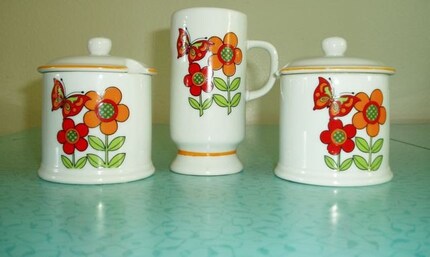
Red is one of my favorite colors... especially for vintage items! Here are a couple lovely red vintage items I've recently come across.


Have a great week!




 Here are some of the things that I've learned. I have quoted from some different sites that had great information for me a newbee to the history of this glassware.
is properly used to describe glass which is made of a comparatively expensive gold solution formula, and is red in color all the way through, solid color. True "Cranberry" glass falls into this group, although it usually has applied clear glass parts.Ruby-Flashed
In the mid 19th century, in Europe (Bohemia) glass workers developed a process of flashing a piece of glass so that had a very thin layer of ruby glass on the outside. This was done by quickly putting the initial gather into a pot of ruby glass and coating the outside (flashing it) with a very thin layer of ruby. The piece was then finished to be a vase, pitcher, whatever.
After the piece had been through the lehr, glass engravers would engrave scenes, building, animals through the ruby glass. We’re all familiar with these Bohemian pieces.
In the 1880s a process was developed whereby a coating could be painted and then fired onto the surface of already-finished glass products. Silver nitrate produced a yellow coating, or stain, and gold chloride produced a ruby coating or stain.
In any case, these pieces came to be called Ruby Stained. Naturally there is some confusion between the products. Almost all flashed glass is blown, where ruby stained glass is mostly pressed, although there is some crossover. Flashed ruby glassware is generally a darker ruby than stained wares, but this, too, is open to interpretation. Generally, ruby stained wares will be personalized, and have a date, while flashed wares will have a scene, or a building, without the personalization.
 I have concluded that this set is Indiana Glass Ruby Band Diamond Point Salt and Pepper.
 I'm seeing all the beautiful red out there for Valentine's Day. Red for myself or someone I love? Well how about both?

I love all of these picks and I am determined to make my kitchen more Retro. The colors are so cheerful. The following range from the 40's through the 70's.Quickly after World War II ended, Americans plowed right into making a wonderful new life for themselves - starting with building their dream kitchens, dream bathrooms - dream houses. Looking at periodicals from 1946, I can see a few distinct trends - this was a transitional period…you still see many Deco influences…you see a lot of primary colors…and definitely, interiors were “sweet”, although in ‘46 homeowners certainly would have declared them “modern.” ......
Tips from the first kitchen image — isn’t the “life through a Pyrex pie plate” awesome?:
- This color combination: Dark cherry red linoleum countertops, primary green linoleum floor, white metal (or wood cabinets) with deco pulls seems to have been very, very common.
- In this image, you also see a light chartreuse green on the wall - this, or yellow, also seem to have been popular secondary colors.
- And flowered fabrics… These kitchens are pure prettiness. Image: Pyrex, of course......Follow the link above to read more.
 Here is a list items and the shops to find these items!